
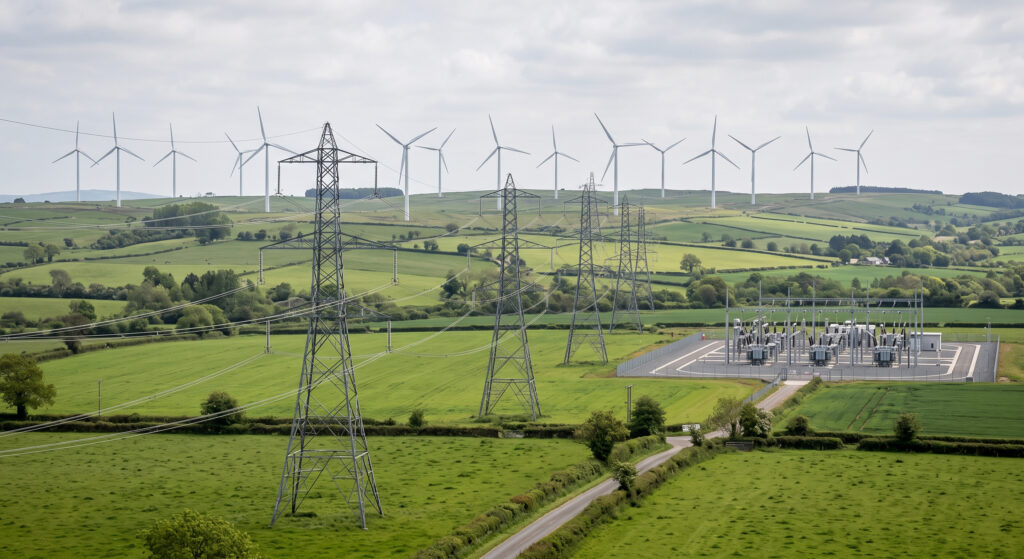
UK grid upgrade faces major delays as renewable energy expansion puts pressure on the power network
The UK’s transition towards a cleaner electricity system is running into a critical infrastructure problem, with major transmission upgrades falling behind schedule and potentially increasing costs for consumers.
Britain is entering a crucial phase in its energy transition. Renewable electricity generation is expanding rapidly, government policy is targeting a predominantly clean power system by 2030, and electricity demand is expected to increase as transport, heating and industry become increasingly electrified.
But the infrastructure required to move that electricity around the country is struggling to keep pace.
A new report from the National Audit Office (NAO) has warned that the £70 billion programme to upgrade Great Britain’s electricity transmission network is facing significant delivery challenges. The watchdog says that completing the required upgrades by 2030 will be “very challenging”, with many projects still at relatively early stages of development.
The issue is becoming increasingly important for the UK’s energy strategy because new wind and solar generation cannot deliver its full value if the electricity cannot be transported to where it is needed.
A network built for a different energy system
Much of Britain’s existing transmission network was developed between the 1950s and 1970s, when the electricity system was dominated by large fossil-fuel power stations.
The geography of generation has changed significantly since then.
Large offshore wind farms are increasingly located far from major centres of electricity demand, particularly around Scotland and the North Sea. At the same time, solar generation is expanding and new electricity demand is emerging from electric vehicles, heat pumps, industrial electrification and other technologies.
The result is a network that increasingly needs to move power over longer distances and handle much larger variations in supply.
The NAO says the current system is already experiencing constraints when the transmission network cannot carry all the electricity being generated to the areas where it is required.
Billions are already being spent managing the problem
When parts of the network become congested, the system operator has to intervene.
In practice, this can mean paying renewable generators, particularly wind farms, to reduce their output while bringing other generators, including gas-fired plants, online elsewhere.
These payments are known as constraint costs.
According to the NAO, constraint costs reached approximately £1.9 billion in 2025-26. Without significant action, the watchdog estimates that they could rise to as much as £7.8 billion by 2030.
The problem therefore has two dimensions.
The UK needs to invest billions in new infrastructure to increase transmission capacity, while at the same time consumers are already paying for the consequences of insufficient capacity.
For the energy industry, this makes grid investment one of the most important infrastructure challenges of the decade.
£70bn grid programme faces a difficult deadline
Ofgem estimates that approximately £70 billion of investment will be required in the electricity transmission network between 2025 and 2031.
The investment is intended to accommodate growing renewable generation, improve resilience and support the government’s Clean Power 2030 objectives.
However, the NAO found that progress remains uneven.
NESO identified more than 80 transmission projects as necessary for the future electricity system. Of these, 64 are currently ongoing, but many remain in the early stages of development and are not expected to connect by the dates originally identified as optimal for reducing constraint costs.
The watchdog also identified planning, supply-chain, skills and system-access issues as factors contributing to the challenge.
This creates a difficult sequencing problem.
Renewable generation can be developed faster than the transmission infrastructure required to transport it. If generation connects first, the UK risks paying increasingly large sums to manage congestion.
If grid development moves too slowly, however, renewable projects may face delays in connecting to the electricity system.
Renewable energy is growing rapidly
The grid challenge comes at a time when Britain’s renewable generation is reaching record levels.
Government energy statistics show that renewable electricity generation reached 43.7 TWh in the first quarter of 2026, an increase of 18% compared with the same period a year earlier.
Wind generation accounted for the majority of that increase, rising 30% to a record 29.3 TWh during the quarter.
The broader direction of travel is clear.
Britain is building more wind and solar capacity, while policy is designed to accelerate the transition away from fossil-fuel generation.
The government expects variable renewable sources such as wind and solar to provide the majority of clean electricity generation by 2030. The House of Commons Library notes that NESO’s pathways estimate that variable renewables could account for between 77% and 82% of generation in 2030.
That makes transmission infrastructure fundamental to the success of the energy transition.
The cost is not only financial
The consequences of delayed grid investment extend beyond electricity bills.
Insufficient network capacity can also affect the development of new industrial facilities, housing, data centres, transport infrastructure and commercial projects that require substantial electricity connections.
The NAO found that the proportion of projects receiving a grid connection offer for the date they wanted fell from approximately 64% in 2019-20 to 16% in 2023-24.
For businesses planning major developments, grid availability is therefore becoming a strategic consideration alongside land, planning permission and construction costs.
This could increasingly influence where new factories, warehouses, data centres and energy-intensive developments are built.
Can the grid be upgraded quickly enough?
The government, Ofgem and NESO have already introduced measures designed to accelerate the process.
These include changes to planning and regulatory processes, earlier investment decisions and reforms intended to improve coordination between the organisations responsible for the electricity system.
But the NAO argues that delivery will ultimately determine whether the programme provides value for money.
The challenge is particularly significant because the UK is attempting to deliver infrastructure at a pace and scale that differs substantially from previous decades.
Transmission projects can require extensive planning, environmental assessments, land agreements, procurement and construction.
They also involve major engineering works, including substations, underground cables, overhead transmission lines and other network infrastructure.
The NAO therefore recommends stronger oversight, greater transparency around individual projects and clearer monitoring of costs and delivery progress.
The construction industry will have a central role
For the UK’s construction and infrastructure sectors, the grid expansion represents a substantial long-term pipeline.
Major transmission upgrades will require civil engineering, specialist electrical construction, tunnelling, cable installation, substations, access roads, environmental works and a wide range of professional services.
The scale of investment also creates opportunities for contractors and suppliers capable of delivering complex energy infrastructure at speed.
However, the industry faces its own capacity constraints.
Skills shortages, specialist equipment requirements, supply-chain pressures and competition for engineering resources could all affect the ability to deliver projects on schedule.
The grid programme therefore has the potential to become one of the UK’s largest infrastructure construction opportunities of the coming decade — but only if the planning and delivery systems can match the ambition.
A critical test for Clean Power 2030
The central issue is becoming increasingly straightforward: Britain cannot build a clean electricity system without building the network required to support it.
Renewable generation is expanding, but generation alone does not guarantee a reliable and affordable electricity system.
The UK needs sufficient transmission capacity, storage, flexibility and balancing capability to move electricity from where it is generated to where it is consumed.
The NAO’s assessment does not suggest that the transition is impossible. Instead, it highlights the delivery risk created by attempting to transform the electricity system within a relatively short period.
The government’s Clean Power 2030 target therefore depends not only on how quickly Britain builds wind farms, solar farms and other low-carbon generation, but also on whether it can build the infrastructure connecting them to consumers.
For households and businesses, the outcome could eventually be reflected in energy bills. For developers and the construction industry, it will increasingly determine which projects can be built, where they can be located and how quickly they can become operational.
The next few years will therefore be critical for Britain’s electricity network.
The renewable generation pipeline is already moving rapidly. The question now is whether the grid can move just as quickly.
Sources: National Audit Office, Upgrading the electricity transmission network; GOV.UK Energy Trends; House of Commons Library.