From Blueprint to Groundbreak: How SMRs Are Restructuring the British Supply Chain
The theoretical debate surrounding Small Modular Reactors has definitively closed. Following the April 2026 contract signing between Great British Energy – Nuclear (GBE-N) and Rolls-Royce SMR, the government has transitioned from technological speculation to active procurement. This framework moves the UK’s nuclear strategy away from generational mega-projects and towards factory-built repeatability. For regional manufacturing hubs and the broader commercial supply chain, this shift represents the most significant pipeline of industrial contracts in a generation.
The Factory-Built Paradigm
Traditional nuclear construction relies on bespoke, on-site engineering that routinely suffers severe delays and budget blowouts. The SMR model fundamentally rewrites this dynamic by treating a power station as a manufactured product rather than a unique civil engineering project. A vast majority of an SMR’s components will be constructed in controlled regional factories before being transported to the final site for assembly.
This modular approach completely decentralises the economic benefit of nuclear power. Major engineering firms, steel fabricators, and advanced manufacturing facilities located hundreds of miles from the final installation site can now secure lucrative, long-term supply contracts. GBE-N is explicitly demanding supply chain capacity that can service a repeatable fleet of reactors, rather than a single, isolated build. This guarantees a stable order book for medium-sized enterprises willing to invest in the strict quality assurance required for nuclear components.
The Wylfa Anchor and Industrial Baseload
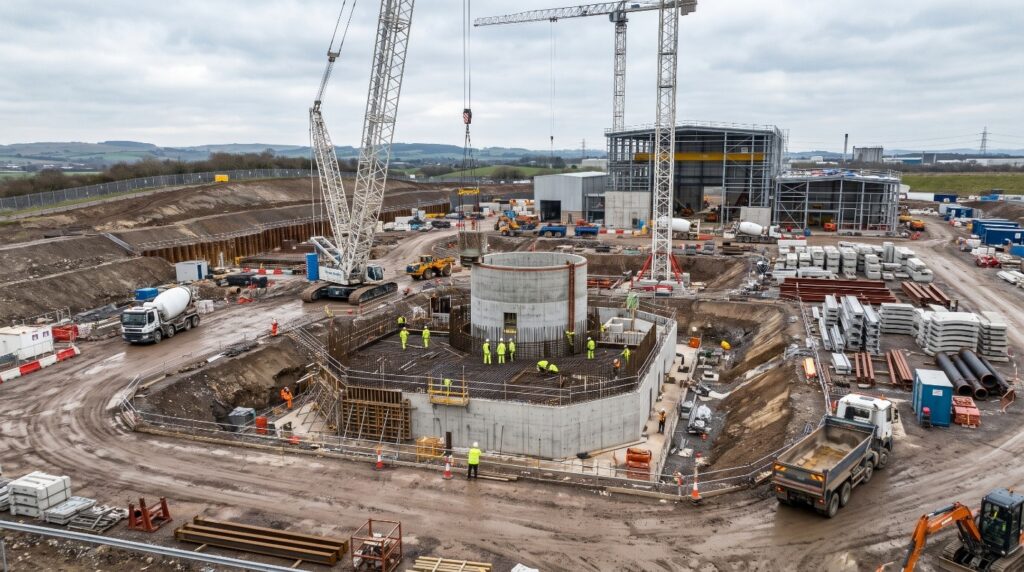
The physical deployment of these units is also reshaping regional economic geography. GBE-N has designated the Wylfa site on Anglesey (now managed as Gwyndod) as the host for the UK’s first SMR deployment. This decision immediately activates a localised procurement sprint for enabling works, encompassing major civil engineering, site characterisation, and facilities management. The initial project alone is forecast to support roughly 3,000 jobs at peak construction.
Beyond the immediate construction footprint, energy-intensive industries are heavily scrutinising these site selections. Heavy manufacturing, chemical processing, and massive data centre operators require constant, zero-carbon baseload power that intermittent renewables simply cannot guarantee. The strategic placement of SMRs near existing regional clusters provides a direct, localised energy feed that bypasses the severe grid constraints currently stalling corporate expansion.
The British state is no longer merely commissioning a single power station; it is attempting to seed an entirely new domestic manufacturing sector. The commercial opportunities are immense, but they carry a strict barrier to entry. Businesses that rapidly align their oper ational standards with nuclear regulatory requirements will secure decades of predictable revenue. Those who wait for the physical foundations to be poured will find the supply chain already locked out.