UK architecture shifts towards retrofit, reuse and people-focused design
Architecture in the UK is increasingly being shaped by the challenge of doing more with existing buildings, with this year’s RIBA National Awards highlighting retrofit, adaptive reuse, affordability and environmental performance alongside new construction.
The latest RIBA National Awards provide a useful snapshot of where British architecture is heading — and one of the clearest messages from the 2026 winners is that good design is increasingly about working with what already exists.
RIBA selected 32 projects for this year’s National Awards, covering housing, education, cultural buildings, infrastructure, workplaces and public spaces across the UK. While the list includes ambitious new-build schemes, a significant number of the recognised projects focus on the repair, adaptation or transformation of existing buildings.
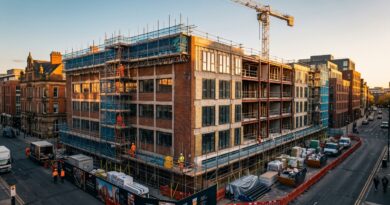
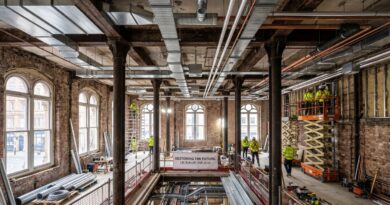
Projects such as Arding & Hobbs in south London, the transformation of Plant, a Grade II-listed 1970s office building in Basingstoke, and the restoration of Space House, a listed Modernist building in London, demonstrate how architects are increasingly treating existing structures as assets rather than obstacles to redevelopment.
From demolition to adaptation
The shift towards reuse is not simply an architectural preference. It reflects a wider change in how the built environment is being assessed.
Existing buildings contain significant embodied carbon in their structures and materials. Retaining those elements can reduce the environmental impact associated with demolition and the manufacture and transportation of new materials.
RIBA’s dedicated Reinvention Award has been established specifically to recognise creative building reuse, with the organisation highlighting retrofit as a way of extending the life, environmental performance and economic value of existing buildings.
The 2026 shortlist includes projects such as Edinburgh Futures Institute, Oru Sutton, Space House and The Buttermarket in Cornwall, illustrating the range of buildings that can be given new purposes rather than replaced.
For architects and developers, this creates a more demanding design challenge. Retrofitting an existing building often means working around structural limitations, heritage requirements, outdated services, accessibility issues and the expectations of future occupants.
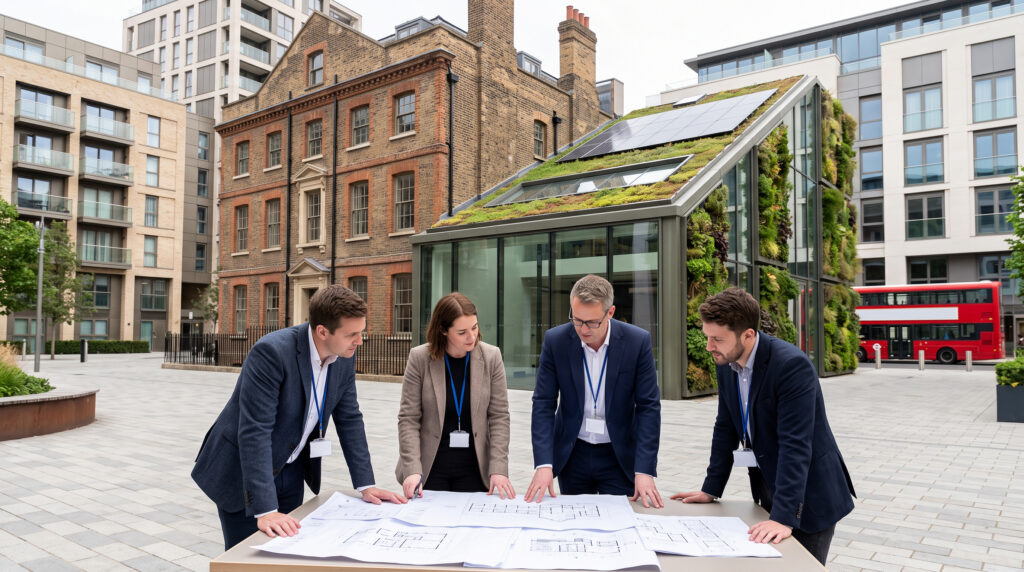
But the result can be architecture that combines historic character with contemporary performance.
Housing remains a major design challenge
The RIBA awards also demonstrate that architectural quality is increasingly being judged alongside affordability and housing delivery.
Several of this year’s winning schemes address the need for new homes while attempting to create better-quality places.
At Canada Water Plot K1, 79 affordable homes form part of the first phase of a major London masterplan. Lion Green Road in Croydon delivers 157 affordable and private homes, while Plashet Road in Newham provides 65 affordable Passivhaus-certified homes alongside a nursery.
These projects demonstrate an important evolution in the role of architecture.
The question is no longer simply how many homes can be delivered on a site. Increasingly, the focus is on how those homes relate to public space, community facilities, environmental performance and the wider urban context.
That approach is particularly significant at a time when the UK is attempting to increase housing supply while facing pressure over construction costs, land values and the quality of new development.
Sustainability is becoming a design requirement
Environmental performance is also becoming more visible in architectural decision-making.
The inclusion of Passivhaus-certified housing among the RIBA winners is significant because it demonstrates that energy performance can be incorporated into large-scale residential design without abandoning architectural quality.
Other projects take different approaches to environmental responsibility. The Rammed Earth House in Wiltshire uses site-sourced rammed earth, while the Urban Nature Project at the Natural History Museum rethinks a five-acre landscape as part of the institution’s wider environmental and educational mission.
This suggests that sustainability in architecture is becoming less about adding individual green technologies and more about making environmental performance part of the fundamental design strategy.
Heritage and contemporary design increasingly overlap
Another notable feature of the 2026 awards is the relationship between new architecture and historic buildings.
The Heritage Quad at York Minster, for example, introduces contemporary architecture into an exceptionally sensitive historic setting. Rather than attempting to imitate the surrounding heritage, the project creates a new architectural language while supporting traditional crafts and technological innovation.
Similarly, the transformation of existing cultural buildings demonstrates how historic structures can remain relevant by accommodating new uses.
At the same time, projects such as Bristol Beacon and BEAM in Hertford show how cultural buildings can be modernised while retaining their relationship with the communities they serve.
The result is a more nuanced approach to conservation: heritage does not necessarily mean freezing a building in time.
Design quality is becoming more closely linked to social value
The strongest theme running through the awards may ultimately be the relationship between architecture and people’s everyday experience.
RIBA’s awards group chair, Neil Gillespie, said the winning projects demonstrate how architects can balance climate change, inclusivity, affordability, accessibility and safety while creating buildings that are useful and valued.
That balance is becoming increasingly important for the UK construction and property sectors.
Developers are under pressure to control costs. Local authorities need more housing and better public facilities. Building owners are dealing with ageing properties and increasingly demanding environmental standards. Meanwhile, communities are demanding better-designed places rather than simply more development.
Architecture sits directly at the intersection of these pressures.
A changing definition of architectural success
The 2026 RIBA awards suggest that British architecture is moving away from the idea that innovation necessarily means building something entirely new.
Innovation can mean transforming a 1970s office, adapting a former department store, converting an industrial building into a home, improving the performance of an existing structure or finding a new use for a historic building.
That does not mean new-build architecture is becoming less important. The awards include major new developments such as UCL East, Sadler’s Wells East, the Brentford Project and the Kepax Footbridge.
Instead, the direction of travel appears to be towards a more balanced architectural culture — one where new construction, retrofit, conservation, environmental performance and social value are considered as part of the same design conversation.
For the UK, that could prove increasingly important over the next decade. With pressure to reduce carbon emissions, deliver more housing and make better use of existing urban land, architects will have to solve increasingly complex problems within increasingly constrained environments.
The projects being recognised today suggest that the future of British architecture may not be defined simply by how spectacular a new building looks.
It may be defined by how intelligently buildings are adapted, how efficiently they perform, how well they serve their communities and how successfully they connect the past with the future.
Source: Royal Institute of British Architects (RIBA), RIBA National Awards 2026 and RIBA Reinvention Award.